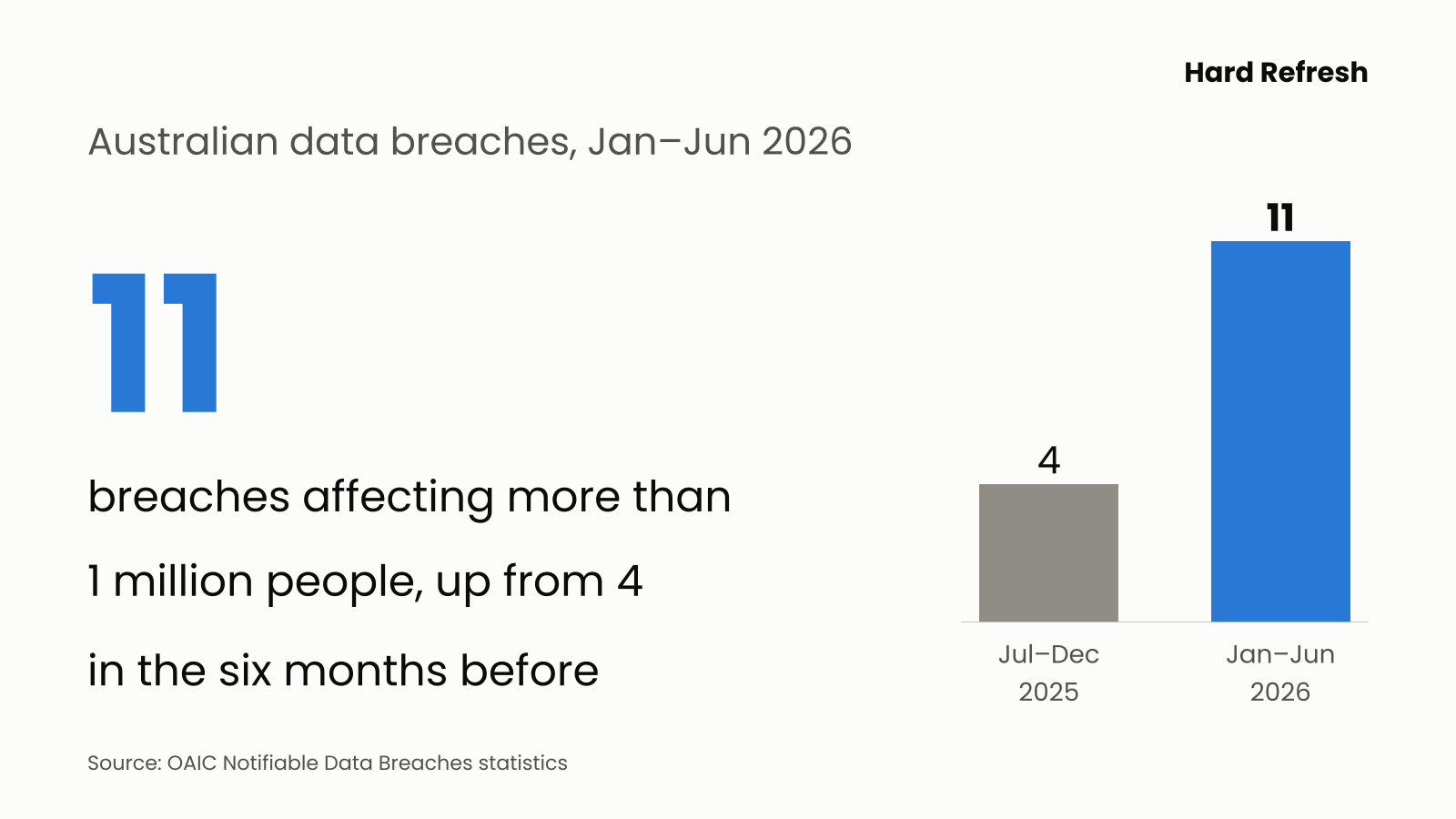
Australian data breaches aren't getting more frequent. They're getting bigger, and the number of people caught up in them is climbing.
It feels like a new breach lands every week. On 16 November, Coles disclosed a cyber incident. The same day, a flaw at Optimizely, a tool companies use to run website experiments, put malicious code on 178 organisations' websites.
So we went looking for whether it is actually getting worse.
Where the numbers come from
The Office of the Australian Information Commissioner (OAIC) is Australia's privacy regulator. Since February 2018, its Notifiable Data Breaches scheme has required organisations covered by the Privacy Act to report any breach likely to cause serious harm. The OAIC publishes the totals every six months.
It is the best public count there is. It also has gaps: most businesses under $3 million turnover are exempt, and it names no companies. To fill that in, we also tracked 16 cyber incidents disclosed by ASX-listed companies since October 2022.
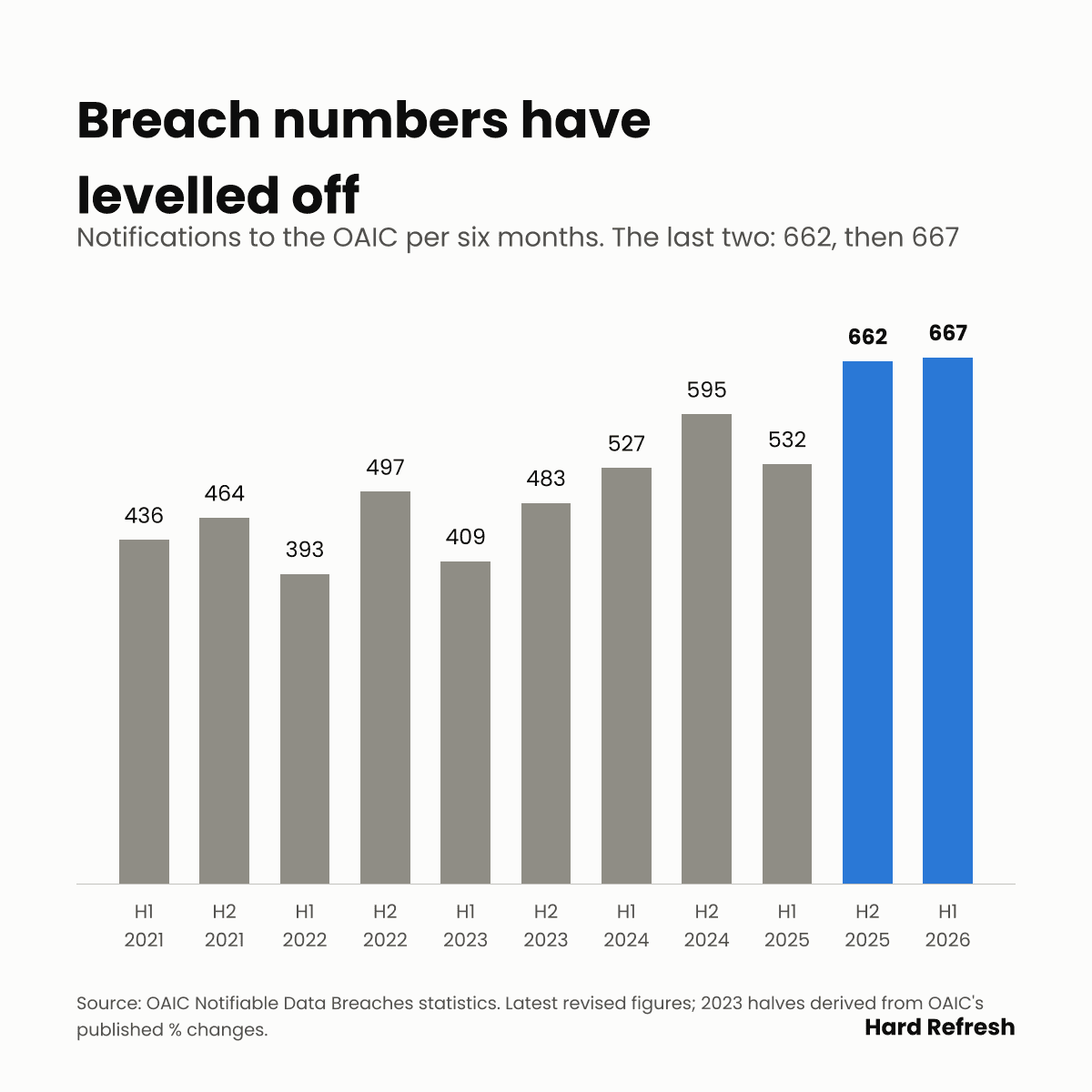
The count is flat. The size isn't.
Notifications rose from 900 in 2021 to a record 1,205 in 2025, then levelled off. The first half of 2026 brought 667, five more than the six months before.
What changed is how many people each breach reaches. Between the second half of 2025 and the first half of 2026:
| People affected per breach | Jul–Dec 2025 | Jan–Jun 2026 |
|---|---|---|
| 100,000 to 250,000 | 3 | 6 |
| 500,000 to 1,000,000 | 0 | 3 |
| More than 1,000,000 | 4 | 11 |
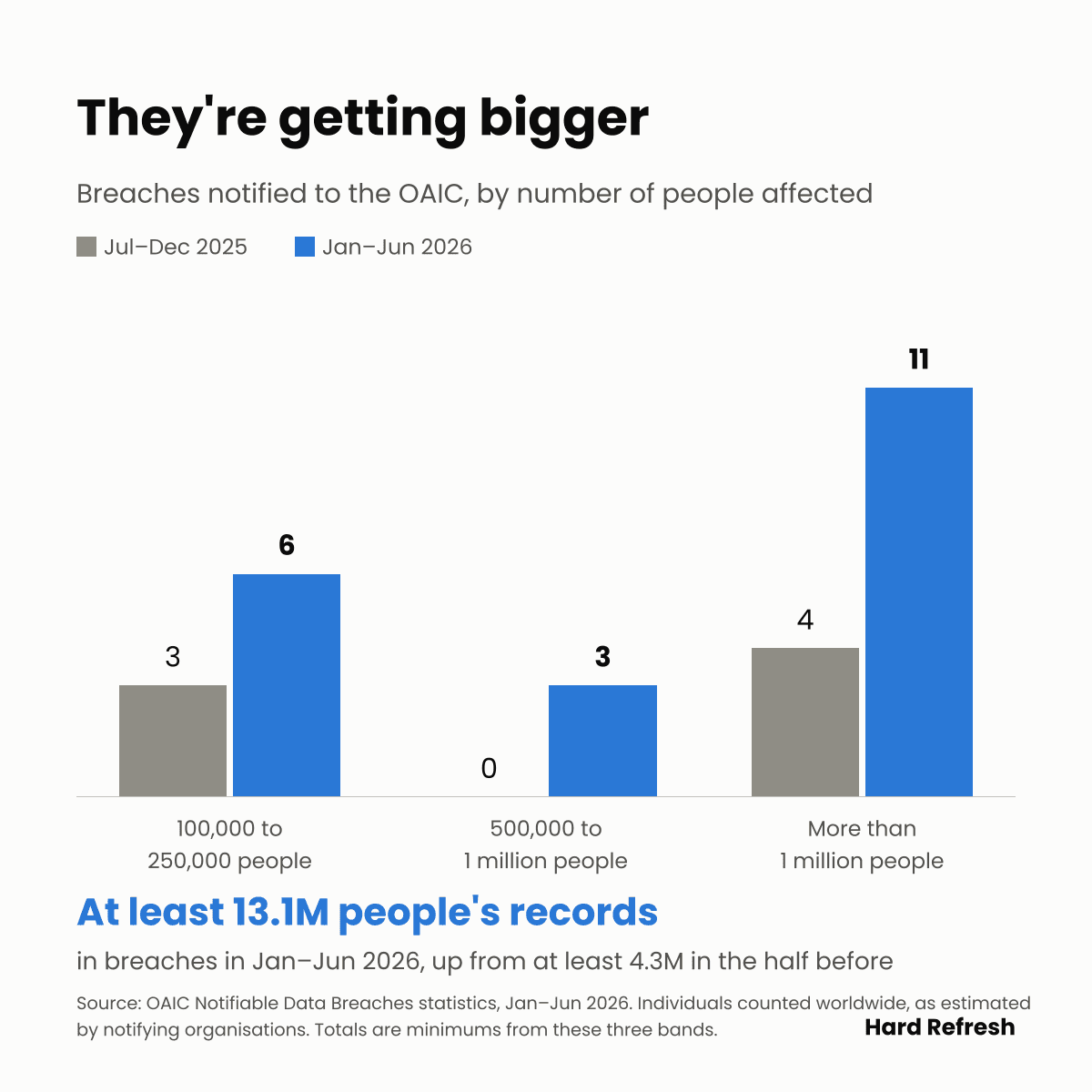
Those three bands alone put at least 13.1 million people's records in breaches in the first half of 2026, against at least 4.3 million in the half before. That is a floor, not an estimate: each band gives only a minimum, and one person can appear in several breaches.
The direction is clear even if the total isn't. Fewer, larger incidents mean more people per incident. If that holds, the number of Australians caught up in breaches keeps rising even when the count doesn't.
People have noticed. In the OAIC's 2026 community attitudes survey, 82% of Australians said they were concerned about data breaches, up from 74% in 2023.
One vendor, hundreds of companies
The big breaches increasingly start somewhere else. Five of the 16 ASX incidents came through a third party:
- Telstra: a third-party staff rewards platform.
- Latitude: an attack believed to originate from a major vendor.
- Qantas: a third-party platform used by one of its contact centres.
- Ansell: vulnerabilities in licensed third-party software.
- Generation Life: access through an external service provider.
The Optimizely attack on 16 November showed how far that reaches. An attacker abused a flaw in Optimizely's account sign-up flow to impersonate admin users and add malicious JavaScript to customer projects. Optimizely's own servers then delivered it to visitors of 178 organisations' websites, including the BBC, CNN, Zoom and HSBC. None of those companies had their own servers breached.
The script skimmed card numbers typed into checkout forms, swapped crypto wallet addresses, and sent visitors' cookies and screenshots to the attacker. The cookies are the quiet risk. A stolen session cookie can let someone into a logged-in account without a password. Cookies marked HttpOnly were out of the script's reach, and the rest should be treated as exposed.
Optimizely says fewer than 5% of its customers were affected. Researchers have since identified nine Australian sites among the victims, including Vodafone Australia and TPG Telecom.
This is the mechanism behind the bigger numbers. Compromise one tool that sits on many websites, and every company using it inherits the breach.
Investors mostly shrug
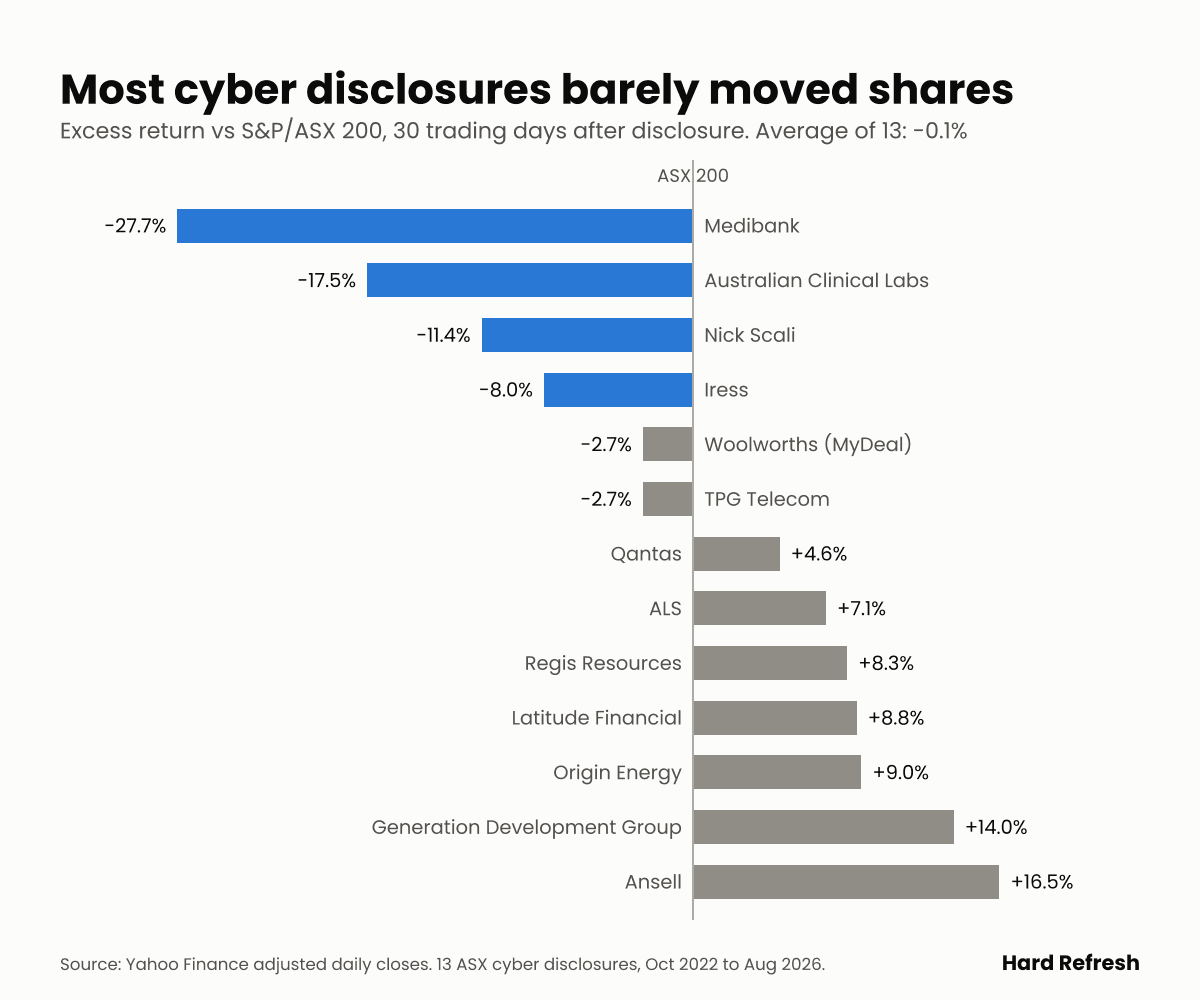
Across the 13 disclosures with 30 days of trading since, six finished behind the index and seven ahead. The number of records did not predict the damage: Qantas (5.7 million customers) and Origin (900,000) both finished ahead.
When the market does react, it is usually to scale arriving late. Medibank lost 1.7% against the index in its first two days, then 18% in one session nine trading days later, when it confirmed the attacker had accessed data for all of its customers. Qantas confirmed 5.7 million affected customers within a week and was level with the index within days.
The four that lost 8% or more had health data confirmed at scale (Medibank, Australian Clinical Labs), operations offline for weeks (Nick Scali), or a breach that grew after the first announcement (Iress).
Most companies speak within three days
The median gap between detecting an incident and announcing it was 3 days, across the 11 companies that gave a usable date. The mean was 31 days, because one took 244. Leave that one out and the mean is 10.
| Company | Detected or aware | Announced | Days |
|---|---|---|---|
| Woolworths (MyDeal) | 14 Oct 2022 | 14 Oct 2022 | 0 |
| Medibank | 12 Oct 2022 | 13 Oct 2022 | 1 |
| Coles | c. 15 Nov 2026 | 16 Nov 2026 | c. 1 |
| Iress | 11 May 2024 | 13 May 2024 | 2 |
| Qantas | 30 Jun 2025 | 2 Jul 2025 | 2 |
| TPG Telecom (iiNet) | 16 Aug 2025 | 19 Aug 2025 | 3 |
| Nick Scali | c. 8 Aug 2026 | 13 Aug 2026 | c. 5 |
| Ansell | 30 Sep 2025 | 14 Oct 2025 | 14 |
| Origin Energy | c. 2 Jul 2026 | 22 Jul 2026 | c. 20 |
| Regis Resources | mid-Nov 2025 | 7 Jan 2026 | c. 53 |
| Australian Clinical Labs | c. 25 Feb 2022 | 27 Oct 2022 | 244 |
The slow ones had reasons on the record. Origin first judged an early-July threat not credible. Regis confirmed its November intrusion after a ransomware group listed it in January. Australian Clinical Labs was later fined $5.8 million, the first civil penalty under the Privacy Act, partly for failing to assess the breach properly.
The ASX does not require an announcement the moment an incident starts. Its guidance asks listed companies to disclose once the facts are material. That is one reason ASX filings are rare: a University of Sydney study counted 20 breach disclosures on the ASX against 3,776 OAIC notifications between 2018 and 2021.
What this means if you hold customer data
The size of a breach is set long before the attack: by how much data you hold, and how many places it sits. Two things shrink it.
Hold less. The smallest breach is the data you never collected, or deleted on time. Every extra field in a CRM, CDP or ad platform adds to the count you would have to report.
Know what runs on your pages. A marketing site carries tags, pixels, testing tools and consent managers from a dozen vendors. Each one runs with the same access as your own code. Of the organisations hit through Optimizely, only about 15% had browser security settings strict enough to block the malware.
Five questions worth answering this week:
- Which systems and vendors hold customer data? Include the marketing stack: CRM, CDP, ad platforms, analytics, form tools.
- Which third-party scripts load on your site, and which of them let someone add custom JavaScript, such as testing tools and tag managers?
- Are your login and session cookies marked HttpOnly and Secure, and is anything sensitive readable by page scripts?
- Is any customer data sitting in tag payloads, data layers or URLs?
- How long would it take to give the board a confirmed count of affected customers?
Most of these sit with marketing and data teams, not security. They are also the first questions we ask when we look at a client's tracking.
Method and caveats
- OAIC figures use the latest revised totals where OAIC has restated them. The 2023 half-year figures are derived from OAIC's published percentage changes. The 13.1 million and 4.3 million figures are floors built from three size bands, counting individuals worldwide as estimated by the notifying organisations.
- Excess return is a stock's return from the close before the announcement to the close 30 trading days later, minus the S&P/ASX 200 over the same days. Prices are adjusted daily closes from Yahoo Finance. An announcement made after the close counts from the next trading day.
- Sample: 14 ASX events, 13 with a full 30 days (Coles is too recent). Telstra is excluded because its disclosure date is unconfirmed. Insignia Financial has no price history available.
- Noise: 30-day windows pick up unrelated news, and trading halts push the reaction to the day trading resumes. Read the share price results as directional, not causal.
- Days to announce counts calendar days from detection or awareness to the first public statement. Four dates are approximate and marked c. Five companies gave no usable date.
- Share prices are as at 17 November 2026. Optimizely details are as at 20 November 2026 and may change as its investigation continues.
Sources
- OAIC: large-scale data breaches on the rise (January to June 2026)
- OAIC: data breach notifications hit an all-time high in 2025
- Cyber Daily: OAIC January to June 2026 statistics
- IDM: OAIC 2026 community attitudes survey
- ABC News: Coles investigates cybersecurity incident
- StepSecurity: Optimizely-hosted scripts hit 178 organisations
- Jscrambler: Optimizely attack facts and timeline
- CMSWire: Optimizely says fewer than 5% of customers affected
- Packetlabs: session cookies and account takeover in the Optimizely attack
- Technology.org: no affected company had its own servers breached
- iTWire: Vodafone Australia and TPG Telecom among affected organisations
- ChannelNews: nine Australian sites among Optimizely victims
- UpGuard: Medibank breach timeline
- Iress ASX release, 15 May 2024
- Latitude ASX announcement, 16 March 2023
- AMI: Qantas confirms 5.7 million customers affected
- Claims Journal: Origin says about 900,000 customers affected
- Digwatch: Regis Resources confirms November intrusion
- Ansell notice of data event
- CBP: first civil penalty under the Privacy Act
- Woolworths Group: MyDeal breach notification
- Gizmodo: Telstra third-party breach
- Cyber Daily: Generation Life confirms customers impacted
- HSF: ASX continuous disclosure guidance on data breaches
- University of Sydney: ASX data breach disclosures study